How to Pick Your Startup's Cheapest AI Model in 2026
Every business has a quiet co-founder named Budget. The AI API market has significantly developed by 2026, and 'cheap' no longer equates to 'bad.' It entails being meticulous about what your product truly requires.
· 14 min read
HowToGetVia score
Scored out of 10 after independent testing. We buy or return every review unit.
Every business has a quiet co-founder named Budget. The AI API market has significantly developed by 2026, and 'cheap' no longer equates to 'bad.' It entails being meticulous about what your product truly requires. With the aid of this advice, you may get the most affordable model without sacrificing your user experience.
Recognize the Cost Tiers for 2026
Three distinct price bands have emerged from the market, and being aware of them helps avoid expensive overbuying.
Commodity Tier. These are the real workhorses; they are frequently distilled or quantized versions of previous flagship models. They are particularly good at low-complexity, high-volume tasks like basic conversation, keyword extraction, summarization, and categorization. Start here if your startup is developing a product description generator or a content moderation pipeline. Pricing is so aggressive that it's sometimes expressed in terms of fractions of a penny per million tokens.
Mid-Tier Balance. At a moderate markup, these models provide a sweet spot of robust reasoning and extensive information. They are perfect for creating marketing content that doesn't seem robotic or for customer service representatives who must adhere to complex regulations. If you're not throwing enormous context windows on every call, costs are still manageable for production traffic while being much higher than the commodity tier.
The Three Factors That Really Count
Use these three glasses to sift thru the hoopla when you visit a provider's price page.
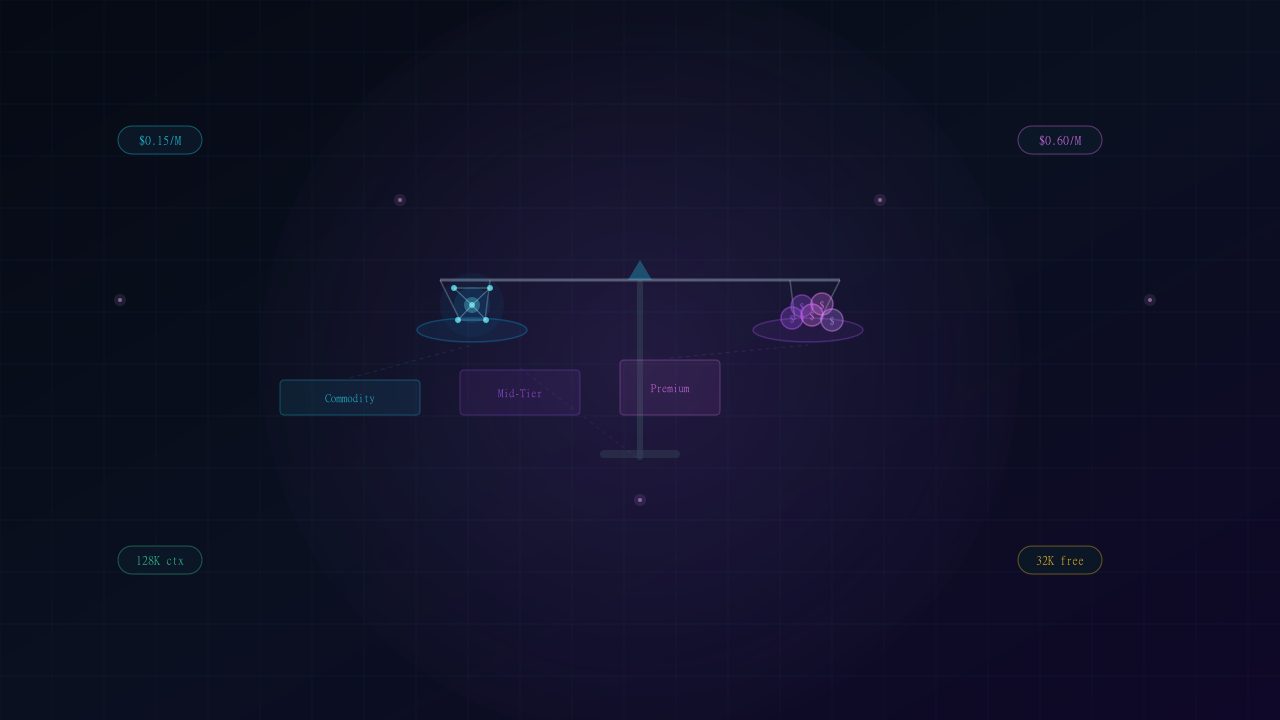
The price per million tokens. This is your baseline, but consider it the beginning rather than the end. Although a model that costs $0.15 per million input tokens and $0.60 per million output tokens may seem inexpensive, your bill will usually be dominated by output expenses. Your anticipated input-to-output ratio should always be modeled. The per-token discount can be eliminated by a verbose model that publishes three paragraphs when one will do.
Length of Context Window. Large context windows are typical in 2026, but how they are priced is the secret. These days, progressive or cache-based pricing is used in many schemes. You may receive 128K tokens of context, however there may be an increasing cost for each token beyond the first 32K. The 'cheapest AI model 2026' on a limited, fixed context may actually be a mid-tier model with an aggressive free caching strategy for repeated prompts if your use case entails dumping in whole documents for analysis.
Fit for Performance. If the output fails, cheap speed is worthless. Benchmark a small, quick model against the next layer up for your particular activity. A fine-tuned or carefully encouraged little model currently outperforms a year-old huge model on specific tasks in several 2026 evaluations. Do a 50-sample test on your real data and score for tone and factual correctness instead of naively relying on public leaderboards. The 80% answer is frequently found in the least expensive bucket.
Your Fast Decision Advice
Start with the market's smallest and quickest model available. Change to a mid-tier model, but just for the particular prompt that failed, if the output quality is inadequate. Install a router that escalates difficult jobs and transfers simple ones to the commodity tier. For companies watching every dollar, this design nearly always provides the finest AI API; you only pay the premium when necessary and receive the bulk discount when it matters.
Sources are linked inline where a claim depends on external reporting.
About the author
Priya NairPriya writes about machine learning systems, developer tooling and the regulation catching up to both. She previously worked as an ML engineer on production recommendation systems.
The Daily Wire
One email. Everything that mattered.
A tight morning briefing on technology, AI and gaming — written by our editors, sent at 07:00 UTC. No sponsored filler, unsubscribe in one click.
We only use your address for the newsletter. See our privacy policy.
Discussion (2)
- Ravi K.2 hours ago
The point about efficiency gains not translating into lower peak power is the part everyone misses. My last build tripped the PSU on transients despite being 200W under the rating.
- Helena W.5 hours ago
Appreciate that the recommendations include 'hold, buy a monitor instead'. Rare to read that in hardware coverage.
Related reading

How to Defend Against AI-Driven Cyberattacks in 2026
From polymorphic malware to deepfake phishing, here's how AI-powered threats are reshaping cybersecurity — and what tech startups can do to survive.

How to Use AI Agents for Workflow Automation in 2026
Your working lives have changed significantly. You no longer need to be directly involved in making every decision when you're in a constant context-switch between email, Slack, project management software, and calendars.

How to Use AI Tools for the Ultimate Gaming Experience in 2026
From AI upscaling to smart NPCs powered by language models, here's how AI tools are transforming the way we play, stream, and experience games in 2026.