How Your Startup May Be Affected by New US AI Regulations in 2026
Early in 2026, the artificial intelligence regulatory environment shifted from theoretical to operational, and the shift did not look like most founders expected.
· 14 min read
HowToGetVia score
Scored out of 10 after independent testing. We buy or return every review unit.
Early in 2026, the artificial intelligence regulatory environment shifted from theoretical to operational, and the shift did not look like most founders expected. Instead of a broad new licensing regime, the US government has moved in narrow, fast-moving actions targeting specific frontier models under national security authority. If your product depends on a cutting-edge API, these actions can affect you even if your startup was never the intended target.
What Actually Happened in June 2026
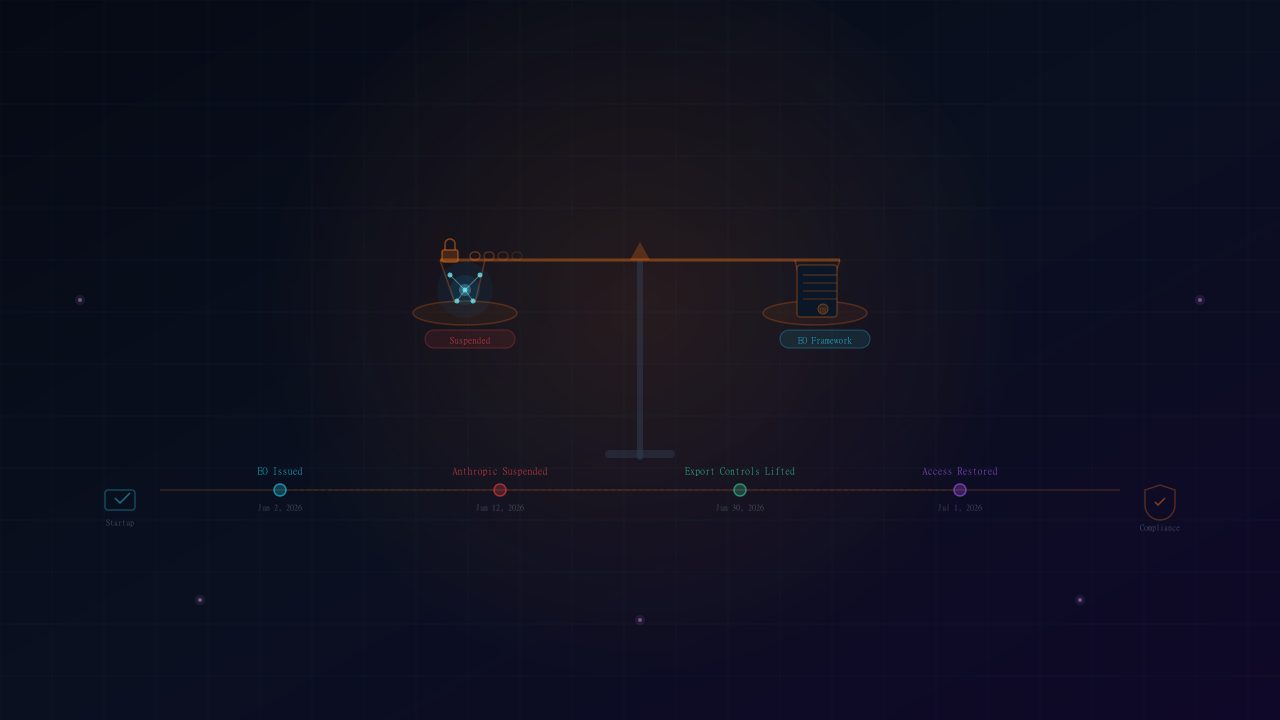
On June 12, 2026, the Commerce Department's Bureau of Industry and Security ordered Anthropic to suspend all foreign national access to its two most capable models at the time, citing a possible jailbreak technique that could be used to bypass safety guardrails around cybersecurity capabilities. Because Anthropic could not reliably distinguish foreign users from domestic ones across its platforms in real time, the company took the unusual step of pulling both models offline for every customer worldwide, not just foreign accounts.
The suspension lasted a little over two weeks. By June 30, the Commerce Department lifted the export controls on the affected models, and Anthropic restored general access on July 1. Throughout the episode, the more advanced of the two models remained available on a restricted basis to a small number of vetted US organizations through a controlled-access program focused on critical infrastructure defense.
This was the first known instance of export control authority being used to pull AI software, rather than chips or hardware, from public access. It set a precedent that founders should take seriously, even though the underlying regulatory framework is narrower than many assumed.
The Executive Order Behind the Scenes
Ten days before the Anthropic suspension, the White House issued an executive order titled 'Promoting Advanced Artificial Intelligence Innovation and Security.' Importantly, this order does not create a mandatory licensing or preclearance requirement for AI models. Instead, it establishes a voluntary framework in which developers of sufficiently advanced systems can provide the federal government with pre-release access, for up to 30 days, so agencies like CISA and the NSA can evaluate cybersecurity risk before public release.
Models that meet a classified benchmarking threshold are designated 'covered frontier models.' Participation by developers is voluntary, but the government has signaled it can and will act quickly outside this framework when it identifies a specific security concern, as the June 12 action against Anthropic demonstrated.
What This Actually Means for Startups
The practical risk for most startups is not a sweeping compliance regime. It is concentration risk: building your core product around a single frontier model that could, in theory, become unavailable on short notice for reasons entirely outside your control. The Anthropic episode showed that even a well-resourced, cooperative AI lab can be forced into a full service suspension with no advance warning to its customers.
If your product's main value proposition depends on one specific frontier API, it is worth asking a blunt question: what happens to your business if that model becomes unavailable for two weeks? For most early-stage companies, the honest answer right now is 'significant disruption,' which is exactly the gap worth closing before it becomes an emergency.
A Practical Playbook for Founders
Diversify your model providers. Avoid architecting your product so that it can only function on a single frontier model from a single vendor. Maintain a tested fallback path using a different provider or a capable but less specialized model, even if it is not your primary choice for performance reasons.
Build for provider-level abstraction. Use an API abstraction layer so switching the underlying model requires a configuration change rather than a rewrite of your application logic. This is the same architectural discipline that protects you against pricing changes, and it happens to protect you against access disruptions too.
Run a tabletop exercise. Ask your team: if our primary model vanished tomorrow, could we migrate customer-facing workloads within 48 hours? If the honest answer is no, that gap is a design problem worth prioritizing now, not after an outage forces the issue.
Watch official channels, not rumors. Regulatory actions in this space have moved quickly and with little advance notice. Following your model provider's official trust and safety announcements, along with Commerce Department press releases, is more reliable than relying on secondhand reporting when decisions need to be made fast.
The takeaway for 2026 is not that AI models are becoming unusable due to regulation. It is that the regulatory environment has shown it can move on individual models, quickly and without warning, for national security reasons unrelated to your product. Founders who treat provider diversification as a structural design choice, rather than an afterthought, are the ones who will absorb the next disruption without it becoming a crisis.
Sources are linked inline where a claim depends on external reporting.
About the author
Tom BrandtTom covers vulnerabilities, incident response and cloud infrastructure. He reads the advisories so you do not have to, and explains what actually needs patching first.
The Daily Wire
One email. Everything that mattered.
A tight morning briefing on technology, AI and gaming — written by our editors, sent at 07:00 UTC. No sponsored filler, unsubscribe in one click.
We only use your address for the newsletter. See our privacy policy.
Discussion (2)
- Ravi K.2 hours ago
The point about efficiency gains not translating into lower peak power is the part everyone misses. My last build tripped the PSU on transients despite being 200W under the rating.
- Helena W.5 hours ago
Appreciate that the recommendations include 'hold, buy a monitor instead'. Rare to read that in hardware coverage.
Related reading
How to Pitch Investors as a First-Time Founder in 2026
Investors aren't evaluating your idea — they're evaluating you. Here's how to structure a pitch that gets the second meeting.
How to Validate Your Startup Idea Before Writing a Single Line of Code
Building something nobody wants is the most expensive mistake in startups. Here's how to test demand for almost no money — before you build.
How to Price Your SaaS Product as an AI Startup in 2026
Pricing is a growth lever, not an afterthought. Here's how AI startups can set prices that cover costs, beat competitors, and scale.